Amulets of Ancient Egypt
Today we will explore some amulets from Ancient Egypt..
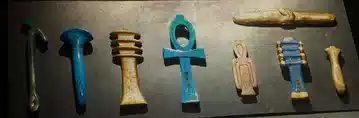
Amulets: The Ankh:
The Ankh, also known as the Ansata cross, is the oldest amulet in Egypt.The Ankh hieroglyphic symbol signifies life or eternal life.It represents respect not only for the material world but, more importantly, for the afterlife—the second life, the realm of the spirit.
The Ankh emblem unites male and female generative principles into a single form. The loop or oval represents the female reproductive organs, while the vertical bar symbolizes the masculine element.
This design resembles the Christian cross but differs in its upper part, which features an oval loop. This loop signifies the floodwaters that inundated the Nile Valley, bringing fertility. The Ankh was closely associated with the goddess Isis, who famously restored life to her husband and brother Osiris. In truth, however, many gods wore the symbol in their immortal capacity.
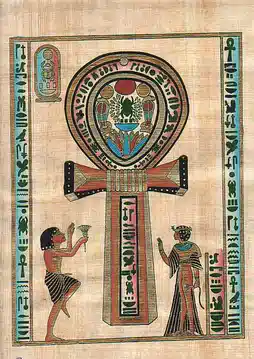 Numerous engravings and sculptures show gods or goddesses holding the Ankh to the nose of another deity or protected figure. This gesture symbolizes imparting the breath of life, which enters through the nostrils. The Ankh is frequently depicted in the hands of Egyptian pharaohs and played a key role during their coronation ceremonies.
The Ankh represents life with a capital L—life that doesn’t end with death but rather awakens anew and continues onward. For this reason, it was often placed on the foreheads of pharaohs, ensuring their eternal vision triumphs over any earthly setback during their reign.
As an amulet, it promotes longevity and the wisdom gained from many lifetimes. Wearing an Ankh talisman invites fertility and abundance; but beyond that, it encourages a spiritual journey beyond the physical realm.
Ieb or Heart:
The ancient Egyptians believed the gods were ‘content’ or satisfied (ieb-neteru-hotep). For them, the heart was the center of thought, emotion, and life itself. During the trial before Osiris, the heart’s weight was measured against the feather of truth and justice (ma’at). Recited spells would declare, “Oh my heart, do not stand as a witness against me; do not oppose me before the judges; do not act against me before the gods; do not be my enemy in the presence of Anubis, guardian of the scales.” Because of this, the ieb amulet was crucial for safe passage to the afterlife. The term ieb also appears in phrases such as “good friend” (ak-ieb), meaning “one who has entered the heart,” “joy” (au-ieb), and in religious expressions like “the heart of the gods is satisfied” (ieb-neteru-hotep).
Heart amulets were made from carnelian, red jasper, red ceramics, or colored paste. Both carnelian and red jasper symbolized energy and the courage to confront invisible enemies. They were connected to the wrath of the gods defending their realms, whose foundation was heavenly rather than driven by animal passions. These stones represented exaltation—the child of heaven.
The Tyet:
The Tyet, or Isis knot, is an amulet symbolizing female regeneration; its deep red color alludes to “the blood of Isis.” Because women are the bearers of life, their role in Egyptian magic was vital, with the goddess Isis, known as the “Lady of Magic,” as its chief symbol. Occasionally, the Tyet also represented the goddesses Nut, Hathor, and Nephthys, where the knot resembled a stylized headband formed by the central and side loops. The Tyet embodied the feminine principle, while the Djed symbolized the masculine, together expressing the dual nature of life and representing the gods Isis and Osiris, parents of Horus. The Tyet sign was also used as a badge of office for palace butlers or “assignees” (jerepah).
The Isis knot, or Tyet, was a stylized depiction of the goddess’s genitals. Nearly every woman wore this amulet to gain the wisdom and knowledge of Isis. It functioned as a fertility charm, most often crafted from red stone and sometimes featuring a green stone inset. Traditionally, it was worn on the throat or chest.
The Uraeus:
The Uraeus, or Ureus, represents the goddess Wadjet. This emblem was the favored protective symbol of many pharaohs, who alone were permitted to wear it as a royal insignia. The term “Uraeus” was introduced by Horapollon, a 5th-century BC scholar of Egyptian hieroglyphs, in his treatise Hieroglyphica, where he offered an ideographic interpretation of hieroglyphic writing. The name has endured since then.
The Uraeus took the form of a cobra and was sometimes adorned with the red crown of Lower Egypt or the white crown of Upper Egypt. The cobra goddess Wadjet often appeared alongside the vulture goddess Nekhbet, symbolizing Lower and Upper Egypt respectively.
Wadjet, originating in the Nile Delta, symbolized Lower Egypt. She was the pharaoh’s protective goddess and appeared as a serpent guarding gods and kings in ancient Egyptian mythology. Wadjet was attributed with immense power and embodied solar goddesses.
Nekhbet, shown as a vulture, symbolized Upper Egypt. She was the protective deity of the pharaoh during childbirth, coronations, jubilees, and battles.
One of the pharaoh’s titles, the Nebty name, includes the Uraeus. This symbol also appears atop many temples and is part of Egyptian crowns as the headband securing the Nemes headdress. Additionally, it is present in the jewelry and amulets of pharaohs and gods.
Cobras and snakes were symbols of resurrection and connected to solar myths about the sun’s journey across the sky and through the underworld, the Duat. They were primarily worshipped in Buto. Upon death, snakes were placed in bronze or wooden boxes adorned with relief carvings of serpents, sometimes with human heads wearing the double crown topped with the Uraeus.
The Djed Pillar:
The Djed Pillar might symbolize the backbone of the god Osiris, a tree, a post made from bound sheaves of grain, or other elements. It’s one of the most frequently depicted symbols in Egyptian mythology, though its exact meaning remains uncertain.
The Djed Pillar may have originated as a prehistoric fetish linked to agricultural rituals. This symbol endured throughout Egyptian iconography, persisting even into the Roman period.
Djed Pillars dating to the time of the First Dynasty have been found at Helwan. Later, during the Old Kingdom, they appeared at Pharaoh Djoser’s burial site at Saqqara, the necropolis of Memphis. This suggests the symbol was linked to concepts such as supporting the sky. Alternatively, it may have been associated with other deities like Sokar and Ptah, gods of Memphis, who are often shown carrying this emblem.
In the New Kingdom, the Papyrus of Ani depicts the Djed Pillar next to the Ankh sign of life. It is shown with arms supporting a rising solar disk, flanked by the goddess sisters Nephthys and Isis, accompanied by monkeys saluting and worshiping the sun. Osiris himself is often portrayed with the Djed Pillar form.
It’s likely that when Osiris, Ptah, and Sokar became linked, the Djed Pillar took on new symbolic meaning within the cult of Osiris as his worship spread broadly. The Djed also appears on the uas scepters held by gods like Thoth and Khonsu.
“The Raising of the Djed Pillar” was a famous ceremony originating in Memphis, probably in honor of the god Ptah, who later became associated with Osiris. This ritual symbolized the stability of the pharaoh’s reign, Osiris’s resurrection, and his triumph over Seth. It served as a periodic renewal, regeneration, and revitalization ceremony, empowering the pharaoh to continue ruling Egypt. The Heb Sed festival also involved this ritual. Evidence of it can be seen, among other places, in the Temple of Seti I at Abydos, a major cult site for Osiris.
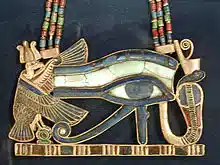 The Eye of Horus stands as one of the most renowned charms from ancient Egypt and continues to hold significance in today's Muslim world. This talisman embodies health, prosperity, the indestructibility of the body, and the capacity for rebirth. Known as the w?jat, it represents an eye that is part human and part hawk—the eye of Horus, the god of the sky. The symbol conveys the meaning of "union" or being "fully restored." These amulets were believed to offer protection not only against disease but also from betrayal, magical spells, curses cast by enemies, and the evil eye.
Regarded as one of the most potent amulets, the eye particularly safeguarded the incision made during mummification to remove the organs. Its design features a circle with a central dot—an image used for thousands of years to symbolize the sun and, by extension, the enduring, eternal power that transcends time.
The beetle was closely connected with the god Khepri—the form of Ra embodying the rising sun—and stood as a symbol of the ongoing transformation inherent in existence.
Among numerous beetle species, the Scarabaeus sacer held a particularly sacred status in ancient Egyptian culture.
Its hieroglyphic name is transliterated as 'xpr,' which translates to 'to become' or 'to transform.' The related term 'xprw' can mean 'form,' 'transformation,' 'event,' 'mode of being,' or even 'self-created,' depending on context, encompassing existential, mythical, or philosophical interpretations.
The beetle was linked with Khepri, the self-created god associated with the sunrise. Ancient beliefs held that the beetle was exclusively male and reproduced by depositing semen into a ball of dung. This act of apparent spontaneous generation mirrored Khepri’s origin, who was also considered self-created from nothing. Additionally, the dung ball rolled by the beetle symbolized the sun itself. Plutarch remarked on this remarkable association:
The Egyptians believed that each day Khepri renewed the sun after it vanished below the horizon, guiding it through the underworld, or Duat, after sunset so it could be reborn at dawn. Some royal tombs from the New Kingdom feature triple depictions of the sun god, accompanied by the beetle symbolizing the morning sun. The astronomical ceiling in Ramses VI’s tomb illustrates the sun’s nightly 'death,' swallowed by Nut, the sky goddess, and its rebirth from her womb as Khepri. The beetle image, emblematic of transformation, renewal, and resurrection, appears extensively across ancient Egyptian funerary and religious art.
Beetle figures were crafted from a range of materials including soapstone, basalt, granite, and precious stones such as lapis lazuli, amethyst, and carnelian, as well as metals like gold. Archaeological finds throughout Egypt have uncovered beetle images made of bone, ivory, stone, Egyptian faience, and valuable metals, dating from the Sixth Dynasty through the Roman period.
Typically small, these beetle amulets were pierced to be strung on necklaces, often bearing brief inscriptions or engraved within an Egyptian cartouche on their base. Commonly worn as protective charms, their backs usually featured figures or text. Some bore the owner's name and served as seals, widely used to mark amphorae containing wine or luxury goods. Pharaohs occasionally commissioned larger beetles inscribed with extensive texts, such as those commemorating Queen Tiye’s wedding. Large beetle sculptures are found in temples across Thebes, in Alexandria’s Serapeum, and various other sites in Egypt.
The beetle played a vital role in Egyptian funerary practices. It was commonly carved from green stone and placed on the chest of the deceased to safeguard the heart, effectively replacing it during mummification. The "heart scarab" was intended to ensure the heart would not testify against its owner during the judgment of the dead. Alternatively, texts inscribed on sarcophagi suggest the deceased’s soul could 'transform' (xpr) into a human, a deity, or even a bird, returning to the world of the living.
Among the most famous heart scarabs is a yellow-green specimen found among King Tutankhamun’s burial goods, expertly carved from a large crystalline mineral sourced from the Libyan Desert.
Mostly fashioned from glazed steatite and varying between 4.7 and 11 cm, these beetle amulets featured inscriptions on their underside. Used as seals bearing representations of the king, his family, and prominent officials during Egypt’s Second Intermediate Period (Hyksos era), they provide crucial information about the Fourteenth and Fifteenth Dynasties. These artifacts have been discovered not only in Egypt but also in Canaan and Kush.
The use of beetle amulets was especially prevalent during Egypt's Eighteenth Dynasty. Pharaoh Thutmose III famously employed them as royal seals. Amenhotep III extensively used them to broadcast achievements and messages related to himself and his royal family throughout his territories. The majority of these amulets celebrated feats like lion hunting—where the king killed lions with his own arrows—or wild bull hunting. Other inscriptions depict his marriage to Queen Tiye, the construction of an artificial lake at the Malkata Palace, or the arrival of the Mitanni princess Kilughepa along with 317 women to the royal harem. These larger, propaganda-style beetles were distributed to courtiers and officials or sent as diplomatic gifts to allied kings.
The beetle remains popular today due to ongoing fascination with ancient Egyptian art and spirituality. Beetle amulets crafted from semi-precious stones or glazed ceramics are widely available in souvenir shops. At the Temple of Karnak, a large beetle statue representing Khepri has been cordoned off to prevent visitors' superstition-driven habit of rubbing its base for good luck; now, those wishing to partake are limited to circling it no more than three times.
It offers protection against envy and betrayal, shielding the wearer from harm before these threats manifest or are even perceived.
Amulets: The Ankh:
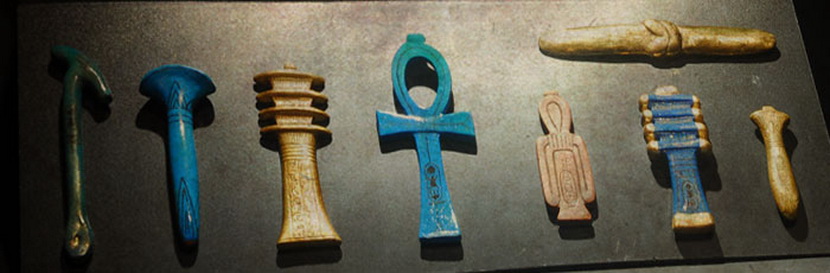
The Ankh, also known as the Ansata cross, is the oldest amulet in Egypt.The Ankh hieroglyphic symbol signifies life or eternal life.It represents respect not only for the material world but, more importantly, for the afterlife—the second life, the realm of the spirit.
The Ankh emblem unites male and female generative principles into a single form. The loop or oval represents the female reproductive organs, while the vertical bar symbolizes the masculine element.
This design resembles the Christian cross but differs in its upper part, which features an oval loop. This loop signifies the floodwaters that inundated the Nile Valley, bringing fertility. The Ankh was closely associated with the goddess Isis, who famously restored life to her husband and brother Osiris. In truth, however, many gods wore the symbol in their immortal capacity.
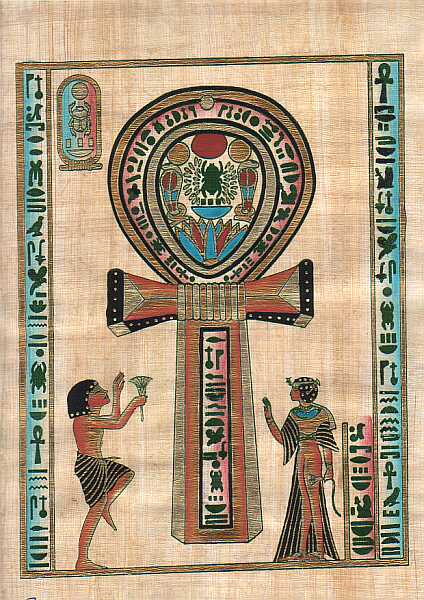 Numerous engravings and sculptures show gods or goddesses holding the Ankh to the nose of another deity or protected figure. This gesture symbolizes imparting the breath of life, which enters through the nostrils. The Ankh is frequently depicted in the hands of Egyptian pharaohs and played a key role during their coronation ceremonies.
The Ankh represents life with a capital L—life that doesn’t end with death but rather awakens anew and continues onward. For this reason, it was often placed on the foreheads of pharaohs, ensuring their eternal vision triumphs over any earthly setback during their reign.
As an amulet, it promotes longevity and the wisdom gained from many lifetimes. Wearing an Ankh talisman invites fertility and abundance; but beyond that, it encourages a spiritual journey beyond the physical realm.
Ieb or Heart:
The ancient Egyptians believed the gods were ‘content’ or satisfied (ieb-neteru-hotep). For them, the heart was the center of thought, emotion, and life itself. During the trial before Osiris, the heart’s weight was measured against the feather of truth and justice (ma’at). Recited spells would declare, “Oh my heart, do not stand as a witness against me; do not oppose me before the judges; do not act against me before the gods; do not be my enemy in the presence of Anubis, guardian of the scales.” Because of this, the ieb amulet was crucial for safe passage to the afterlife. The term ieb also appears in phrases such as “good friend” (ak-ieb), meaning “one who has entered the heart,” “joy” (au-ieb), and in religious expressions like “the heart of the gods is satisfied” (ieb-neteru-hotep).
Heart amulets were made from carnelian, red jasper, red ceramics, or colored paste. Both carnelian and red jasper symbolized energy and the courage to confront invisible enemies. They were connected to the wrath of the gods defending their realms, whose foundation was heavenly rather than driven by animal passions. These stones represented exaltation—the child of heaven.
The Tyet:
The Tyet, or Isis knot, is an amulet symbolizing female regeneration; its deep red color alludes to “the blood of Isis.” Because women are the bearers of life, their role in Egyptian magic was vital, with the goddess Isis, known as the “Lady of Magic,” as its chief symbol. Occasionally, the Tyet also represented the goddesses Nut, Hathor, and Nephthys, where the knot resembled a stylized headband formed by the central and side loops. The Tyet embodied the feminine principle, while the Djed symbolized the masculine, together expressing the dual nature of life and representing the gods Isis and Osiris, parents of Horus. The Tyet sign was also used as a badge of office for palace butlers or “assignees” (jerepah).
The Isis knot, or Tyet, was a stylized depiction of the goddess’s genitals. Nearly every woman wore this amulet to gain the wisdom and knowledge of Isis. It functioned as a fertility charm, most often crafted from red stone and sometimes featuring a green stone inset. Traditionally, it was worn on the throat or chest.
The Uraeus:
The Uraeus, or Ureus, represents the goddess Wadjet. This emblem was the favored protective symbol of many pharaohs, who alone were permitted to wear it as a royal insignia. The term “Uraeus” was introduced by Horapollon, a 5th-century BC scholar of Egyptian hieroglyphs, in his treatise Hieroglyphica, where he offered an ideographic interpretation of hieroglyphic writing. The name has endured since then.
The Uraeus took the form of a cobra and was sometimes adorned with the red crown of Lower Egypt or the white crown of Upper Egypt. The cobra goddess Wadjet often appeared alongside the vulture goddess Nekhbet, symbolizing Lower and Upper Egypt respectively.
Wadjet, originating in the Nile Delta, symbolized Lower Egypt. She was the pharaoh’s protective goddess and appeared as a serpent guarding gods and kings in ancient Egyptian mythology. Wadjet was attributed with immense power and embodied solar goddesses.
Nekhbet, shown as a vulture, symbolized Upper Egypt. She was the protective deity of the pharaoh during childbirth, coronations, jubilees, and battles.
One of the pharaoh’s titles, the Nebty name, includes the Uraeus. This symbol also appears atop many temples and is part of Egyptian crowns as the headband securing the Nemes headdress. Additionally, it is present in the jewelry and amulets of pharaohs and gods.
Cobras and snakes were symbols of resurrection and connected to solar myths about the sun’s journey across the sky and through the underworld, the Duat. They were primarily worshipped in Buto. Upon death, snakes were placed in bronze or wooden boxes adorned with relief carvings of serpents, sometimes with human heads wearing the double crown topped with the Uraeus.
The Djed Pillar:
The Djed Pillar might symbolize the backbone of the god Osiris, a tree, a post made from bound sheaves of grain, or other elements. It’s one of the most frequently depicted symbols in Egyptian mythology, though its exact meaning remains uncertain.
The Djed Pillar may have originated as a prehistoric fetish linked to agricultural rituals. This symbol endured throughout Egyptian iconography, persisting even into the Roman period.
Djed Pillars dating to the time of the First Dynasty have been found at Helwan. Later, during the Old Kingdom, they appeared at Pharaoh Djoser’s burial site at Saqqara, the necropolis of Memphis. This suggests the symbol was linked to concepts such as supporting the sky. Alternatively, it may have been associated with other deities like Sokar and Ptah, gods of Memphis, who are often shown carrying this emblem.
In the New Kingdom, the Papyrus of Ani depicts the Djed Pillar next to the Ankh sign of life. It is shown with arms supporting a rising solar disk, flanked by the goddess sisters Nephthys and Isis, accompanied by monkeys saluting and worshiping the sun. Osiris himself is often portrayed with the Djed Pillar form.
It’s likely that when Osiris, Ptah, and Sokar became linked, the Djed Pillar took on new symbolic meaning within the cult of Osiris as his worship spread broadly. The Djed also appears on the uas scepters held by gods like Thoth and Khonsu.
“The Raising of the Djed Pillar” was a famous ceremony originating in Memphis, probably in honor of the god Ptah, who later became associated with Osiris. This ritual symbolized the stability of the pharaoh’s reign, Osiris’s resurrection, and his triumph over Seth. It served as a periodic renewal, regeneration, and revitalization ceremony, empowering the pharaoh to continue ruling Egypt. The Heb Sed festival also involved this ritual. Evidence of it can be seen, among other places, in the Temple of Seti I at Abydos, a major cult site for Osiris.
The Eye of Horus, known as “the all-seeing eye,”:
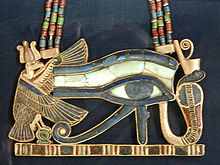
Regarded as one of the most potent amulets, the eye particularly safeguarded the incision made during mummification to remove the organs. Its design features a circle with a central dot—an image used for thousands of years to symbolize the sun and, by extension, the enduring, eternal power that transcends time.
The beetle as a charm:
The beetle served as an amulet symbolizing life and strength. Modeled after the dung beetle (Scarabaeus sacer) native to Egypt, it represented the rising sun and was a powerful emblem of resurrection in Egyptian mythology. It was believed to offer protection from visible and invisible evils and to grant daily vigor and power. For the deceased, carrying this amulet meant achieving the ability to resurrect and attain eternal life.The beetle was closely connected with the god Khepri—the form of Ra embodying the rising sun—and stood as a symbol of the ongoing transformation inherent in existence.
Among numerous beetle species, the Scarabaeus sacer held a particularly sacred status in ancient Egyptian culture.
Its hieroglyphic name is transliterated as 'xpr,' which translates to 'to become' or 'to transform.' The related term 'xprw' can mean 'form,' 'transformation,' 'event,' 'mode of being,' or even 'self-created,' depending on context, encompassing existential, mythical, or philosophical interpretations.
The beetle was linked with Khepri, the self-created god associated with the sunrise. Ancient beliefs held that the beetle was exclusively male and reproduced by depositing semen into a ball of dung. This act of apparent spontaneous generation mirrored Khepri’s origin, who was also considered self-created from nothing. Additionally, the dung ball rolled by the beetle symbolized the sun itself. Plutarch remarked on this remarkable association:
The Egyptians believed that each day Khepri renewed the sun after it vanished below the horizon, guiding it through the underworld, or Duat, after sunset so it could be reborn at dawn. Some royal tombs from the New Kingdom feature triple depictions of the sun god, accompanied by the beetle symbolizing the morning sun. The astronomical ceiling in Ramses VI’s tomb illustrates the sun’s nightly 'death,' swallowed by Nut, the sky goddess, and its rebirth from her womb as Khepri. The beetle image, emblematic of transformation, renewal, and resurrection, appears extensively across ancient Egyptian funerary and religious art.
Beetle figures were crafted from a range of materials including soapstone, basalt, granite, and precious stones such as lapis lazuli, amethyst, and carnelian, as well as metals like gold. Archaeological finds throughout Egypt have uncovered beetle images made of bone, ivory, stone, Egyptian faience, and valuable metals, dating from the Sixth Dynasty through the Roman period.
Typically small, these beetle amulets were pierced to be strung on necklaces, often bearing brief inscriptions or engraved within an Egyptian cartouche on their base. Commonly worn as protective charms, their backs usually featured figures or text. Some bore the owner's name and served as seals, widely used to mark amphorae containing wine or luxury goods. Pharaohs occasionally commissioned larger beetles inscribed with extensive texts, such as those commemorating Queen Tiye’s wedding. Large beetle sculptures are found in temples across Thebes, in Alexandria’s Serapeum, and various other sites in Egypt.
The beetle played a vital role in Egyptian funerary practices. It was commonly carved from green stone and placed on the chest of the deceased to safeguard the heart, effectively replacing it during mummification. The "heart scarab" was intended to ensure the heart would not testify against its owner during the judgment of the dead. Alternatively, texts inscribed on sarcophagi suggest the deceased’s soul could 'transform' (xpr) into a human, a deity, or even a bird, returning to the world of the living.
Among the most famous heart scarabs is a yellow-green specimen found among King Tutankhamun’s burial goods, expertly carved from a large crystalline mineral sourced from the Libyan Desert.
Mostly fashioned from glazed steatite and varying between 4.7 and 11 cm, these beetle amulets featured inscriptions on their underside. Used as seals bearing representations of the king, his family, and prominent officials during Egypt’s Second Intermediate Period (Hyksos era), they provide crucial information about the Fourteenth and Fifteenth Dynasties. These artifacts have been discovered not only in Egypt but also in Canaan and Kush.
The use of beetle amulets was especially prevalent during Egypt's Eighteenth Dynasty. Pharaoh Thutmose III famously employed them as royal seals. Amenhotep III extensively used them to broadcast achievements and messages related to himself and his royal family throughout his territories. The majority of these amulets celebrated feats like lion hunting—where the king killed lions with his own arrows—or wild bull hunting. Other inscriptions depict his marriage to Queen Tiye, the construction of an artificial lake at the Malkata Palace, or the arrival of the Mitanni princess Kilughepa along with 317 women to the royal harem. These larger, propaganda-style beetles were distributed to courtiers and officials or sent as diplomatic gifts to allied kings.
The beetle remains popular today due to ongoing fascination with ancient Egyptian art and spirituality. Beetle amulets crafted from semi-precious stones or glazed ceramics are widely available in souvenir shops. At the Temple of Karnak, a large beetle statue representing Khepri has been cordoned off to prevent visitors' superstition-driven habit of rubbing its base for good luck; now, those wishing to partake are limited to circling it no more than three times.
The scorpion as an amulet:
The scorpion charm is worn as a protective talisman guarding against insect and venomous snake bites. Typically fashioned from green malachite or tourmaline, it is crafted as a pendant or ring and is associated astrologically with the signs Virgo and Scorpio.It offers protection against envy and betrayal, shielding the wearer from harm before these threats manifest or are even perceived.
Bibliography
- Hall, Judy. The Crystal Bible Volume 2. Godsfield Press, 2009. ISBN 9781841813509. Source.
- Budge, E. A. Wallis. Amulets and Superstitions. Oxford University Press, H. Milford, 1930, xxxix + 543 pp. Source.
- Johnston, Jay. Amulets in Magical Practice. Elements in Magic, Cambridge University Press, 2024, 80 pp. DOI 10.1017/9781108953412. Online ISBN 9781108953412. Cambridge Core. Source.