Umbanda Rituals
"There is only one evil we should truly fear: the darkness that remains within ourselves." Chico Xavier
"Do not plead with powerless gods; within yourself lies what is needed for liberation. Each man builds his own prison."
Umbanda Ritual: A ritual is a ceremonial sequence of practices designed to organize the environment and focus the mind on a specific task. It helps structure and direct thought toward a particular purpose. Umbandas seek to instill discipline in the medium, enabling an easier and more harmonious tuning with the spirit guides. Given our current stage of spiritual evolution, we still require support to direct both our mind and willpower effectively.
Elements of Umbanda Rituals
Ogan: The Ogan is in charge of the leather drum, called curimba, playing the drums and leading the singing. Within the magic, the Ogan neutralizes negative energies and invokes entities. This role demands great firmness due to the significant responsibility involved. In traditional "Pure Umbanda" households, drums are absent and songs are accompanied solely by hand clapping. The Ogan positions themselves in front of the altar, and no one should stand before or above the singer.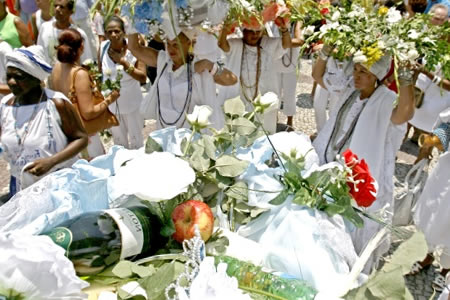
The circle surrounding a point serves to restrict the channel. If the circle is not drawn, it signifies that the channel opens to the entire environment.
CandlesCandles play an important role in Umbanda rituals as a source of flame. When a candle is lit, its value lies not in the wax but in the fire, which burns away impurities from the environment, purifying and renewing the surrounding air. It acts as a psychological tool, awakening latent extrasensory abilities. Confused, scattered, or misguided thoughts can channel negative influences or simply render the ritual ineffective.
WaterPots filled with water are used to channel the energies of Xango, Yemanja, and other guiding entities. These pots are kept open, adorned with flowers nearby, and should never be covered, refrigerated, or filtered. Anyone may take the water unless it is specifically dedicated as an offering to an individual entity.
Characteristics of the Umbanda Ritual
BarefootShoes are considered unhygienic, as they carry debris, decay, and other impurities. Being barefoot allows direct contact with the Earth element, enabling a natural release of vibrations.
Tobacco and AlcoholCachaça is an excellent aid in eliminating negative energies during Umbanda rituals. Alcohol induces a slight psychic numbness in the medium, facilitating the work of the entities under the medium's control. Cigarette smoke acts as a purifier that destroys heavy burdens; entities do not linger in the smoke. Although mental strength is predominantly used in modern Umbanda rituals, tobacco and rum are still employed in some places.
Smoking: Smoke is used to control the environment by dispelling negative energies. The aroma of herbs serves to cleanse and neutralize harmful influences. The smoking process should always be guided by the spirit guides, as they oversee the progression and proper conclusion of the work.
NecklacesNecklaces serve as energy reservoirs, holding both positive and negative energies. They are often crafted from natural materials such as stones, pearls, seeds, or wood. The necklace absorbs the positive energy of the Guide and transfers it to the patient, then gathers the patient's negative energy and returns it to the Guide.
Variety of Rituals
Although at least seven distinct Afro-Brazilian cult ritual systems exist, within Umbanda itself, several different ritual traditions can be identified.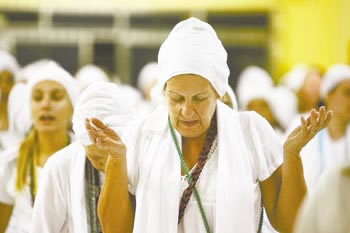 Despite efforts by Umbanda congresses to unify rituals, these traditions have gradually diverged, largely depending on the degree of incorporation of Kardecist doctrine or Equatorial Guinean influences. We can broadly categorize five primary Umbanda rites, primarily based on the balance between Spiritist and Equatorial Guinean elements:
Spiritist Ritual
Also known as "Puritan Umbanda," this ritual is practiced mainly in spiritualized circles. Here, the orixás are understood as spirits of the dead, with a strong influence from Kardecist doctrine. Generally, this ritual avoids the use of images or dance.
Ritualist
This ritual features hand clapping and abundant music. Practitioners always wear white robes during sessions. Dances, images, and orixá sanctuaries are prominently present. Unlike Spiritist rituals, entities are not interpreted as spirits of the deceased but rather as orixás.
Rhythmic
More primitive than the previous types and often termed "African," this ritual centers on percussion elements that accompany and sustain the dances.
Rhythmic and Ritualized
This ritual has a strong folk origin and is heavily influenced by another syncretic tradition, Candomblé. Musical instruments are used continuously during sessions, and the liturgical robes are brightly colored according to the orixá under whose protection the work proceeds.
Esoteric or Kabbalistic
Strongly influenced by Eastern cults and religions, adherents claim that Umbanda is not a purely Brazilian religion but rather a revival of an ancient, nearly forgotten Oriental practice. They describe it as a "popular, white, and esoteric religion devoted to the practice of pure charity."
Rhythmic
More primitive than the previous types and often termed "African," this ritual centers on percussion elements that accompany and sustain the dances.
Rhythmic and Ritualized
This ritual has a strong folk origin and is heavily influenced by another syncretic tradition, Candomblé. Musical instruments are used continuously during sessions, and the liturgical robes are brightly colored according to the orixá under whose protection the work proceeds.
Esoteric or Kabbalistic
Strongly influenced by Eastern cults and religions, adherents claim that Umbanda is not a purely Brazilian religion but rather a revival of an ancient, nearly forgotten Oriental practice. They describe it as a "popular, white, and esoteric religion devoted to the practice of pure charity."
Rhythmic and Ritualized
This ritual has a strong folk origin and is heavily influenced by another syncretic tradition, Candomblé. Musical instruments are used continuously during sessions, and the liturgical robes are brightly colored according to the orixá under whose protection the work proceeds.Esoteric or Kabbalistic
Strongly influenced by Eastern cults and religions, adherents claim that Umbanda is not a purely Brazilian religion but rather a revival of an ancient, nearly forgotten Oriental practice. They describe it as a "popular, white, and esoteric religion devoted to the practice of pure charity."Baths in Umbanda Rituals
There are several types of spiritual baths, but none should be undertaken without proper spiritual guidance. Each bath must be tailored to the individual's specific situation.Bath DisclaimerThese baths are recommended for people saturated with negative energies. The goal is to use positive energy to counteract negativity. Activation baths work on emotional and spiritual levels, absorbing energy through the Crown Chakra, and thus should be applied from head to toe.
Red Roses BathUsed to release energy and dispel negative fluids, this bath helps identify weak points in the aura so that guardians can focus their work.
White Roses BathThis bath encourages positive energy emissions and typically involves three roses. It is advisable to wait at least 72 hours between baths.
Coarse Salt BathDesigned for cleansing and grounding, this bath should not be applied over the entire body but only from the shoulders down to the feet.
In summary, Umbanda is like any religion, rich in rituals that must be respected for the work to proceed correctly. Our guides act in good faith and oversee the fulfillment of our duties.
This concludes our article on Umbanda rituals and the characteristic elements of Umbanda witchcraft. Continue exploring this website to learn more about home rituals, spells, and love charms.